I have a few A Mathematician And... jokes for you this week.
A physicist and a mathematician are sitting in a faculty lounge. Suddenly,
the coffee machine catches on fire. The physicist grabs a bucket and leap
towards the sink, filled the bucket with water and puts out the fire. Second
day, the same two sit in the same lounge. Again, the coffee machine catches
on fire. This time, the mathematician stands up, got a bucket, hands the
bucket to the physicist, thus reducing the problem to a previously solved
one.
A biologist, a physicist and a mathematician were sitting in a street
cafe watching the crowd. Across the street they saw a man and a woman entering
a building. Ten minutes they reappeared together with a third person.
- They have multiplied, said the biologist.
- Oh no, an error in measurement, the physicist sighed.
- If exactly one person enters the building now, it will be empty again,
the mathematician concluded.
Several scientists were all posed the following question: "What is 2
* 2 ?"
The engineer whips out his slide rule (so it's old) and shuffles it
back and forth, and finally announces "3.99".
The physicist consults his technical references, sets up the problem
on his computer, and announces "it lies between 3.98 and 4.02".
The mathematician cogitates for a while, then announces: "I don't know
what the answer is, but I can tell you, an answer exists!".
Philosopher smiles: "But what do you mean by 2 * 2 ?"
Logician replies: "Please define 2 * 2 more precisely."
The sociologist: "I don't know, but is was nice talking about it".
Behavioral Ecologist: "A polygamous mating system".
Medical Student : "4"
All others looking astonished : "How did you know ??"
Medical Student : :I memorized it."
A physicist, a mathematician, and a mystic were asked to name
the greatest invention of all time. The physicist chose the fire,
which gave humanity the power over matter.
The mathematician chose the alphabet, which
gave humanity power over symbols. The mystic chose the thermos bottle.
"Why a thermos bottle?" the others asked.
"Because the thermos keeps hot liquids hot in winter and cold liquids cold
in summer."
"Yes -- so what?"
"Think about it." said the mystic reverently. That little bottle -- how
does it *know*?"
A mathematician, a physicist, and an engineer were traveling through
Scotland when they saw a black sheep through the window of the train.
"Aha," says the engineer, "I see that Scottish sheep are black."
"Hmm," says the physicist, "You mean that some Scottish sheep are black."
"No," says the mathematician, "All we know is that there is at least
one sheep in Scotland, and that at least one side of that one sheep is
black!"
A mathematician, a physicist, and an engineer are all given identical
rubber balls and told to find the volume. They are given anything
they want to measure it, and have all the time they need.
The mathematician pulls out a measuring tape and records the
circumference. He then divides by two times pi to get the radius,
cubes that, multiplies by pi again, and then multiplies by four-thirds
and thereby calculates the volume.
The physicist gets a bucket of water, places 1.00000 gallons of water
in the bucket, drops in the ball, and measures the displacement to six
significant figures.
And the engineer? He writes down the serial number of the ball, and
looks it up.
There are many more here. Enjoy!

Monday, 1 October 2012

Sunday, 30 September 2012
My New Home
Today was a big day. I moved into my room at University. I don't really feel ready for it. I don't think I've ever cried so much when my mum and my boyfriend left.
But my room is really nice. It is a decent size, and has everything I need in it to help me survive my first year at Uni.
 I am going to miss everyone so much, but I still want to have a good time. Right now I still feel a bit helpless, but it should get better. I have an introductory lecture tomorrow morning, so that should clear some things up for me about my course, and I get to meet my personal tutor.
 Can you tell I'm a maths student?
This is the start of a very big adventure.
But my room is really nice. It is a decent size, and has everything I need in it to help me survive my first year at Uni.


This is the start of a very big adventure.
Tuesday, 25 September 2012
Fibonacci
Leonardo da Pisa (otherwise known as Fibonacci) was an Italian mathematician born around 1770. Fibonacci is known for popularising the Arabic numerals (1, 2, 3 etc.) in Christian Europe, but is probably most famous for the number sequence he published in his book, Liber Abaci. The Fibonacci Sequence. This sequence of numbers was actually already known to Indian mathematicians as early as the 6th Century, but Fibonacci was the one who introduced it to the West.
Fibonacci originally came across the sequence when trying to solve a problem to do with the growth rate of rabbit populations. His problem was this:
Let a pair of baby rabbits into a fenced off garden. After a month they will mature into adult rabbits. Every month after that they will produce another pair of rabbits. If every pair of rabbits follows this model, and assuming none of the rabbits die, how many rabbits will there be after a year?
Obviously this theoretical model was created based on some very crude assumptions. For starters, the rabbits never die (which clearly wouldn't happen). Also it assumes that rabbits mate for life, they consistently produce another pair every month who also mate for life, and only take a month to mature into rabbits who can reproduce. These assumptions meant that he wasn't accurately predicting the growth rates of rabbits, but he did produce a sequence that is still used today, in science and in nature!

This image shows how the model plays out when you apply the limitations and run it through. The orange rabbits are the babies, and the white rabbits are when they have matured. When an arrow points from a white pair to a white pair, it shows the same pair of rabbits. The sequence Fibonacci ended up with was 1, 1, 2, 3, 5, 8, 13, 21... and so on. This is the famous Fibonacci Sequence. It is so famous because it has some interesting properties.
- The most obvious property is that every term in the sequence is the sum of the previous two. For example, 1+1=2, 1+2=3, 2+3=5 and so on.
- When you add the terms of the sequence (1+1=2, 1+1+2=4, 1+1+2+3=7) the answers create a new sequence that is similar to the original. When you add n terms of the Fibonacci Sequence together, the total equals the (n+2)th (for want of a better description...) term minus 1. For example, if you add the first 5 terms of the Fibonacci Sequence, the answer is the 7th term of the Fibonacci Sequence minus 1.
New 2 4 7 12 20 33 54...
- When you add the squares of the Fibonacci numbers, you get another sequence. It just so happens there is an easy way to work out the sum up to the nth term of the squared sequence by using the Fibonacci Sequence. Say you want to work out the 5th term of the sum of squares, you take the 5th and 6th Fibonacci numbers and multiply them together. It comes out to the same number. In this case, 5x8=40.
Squares 1 1 4 9 25 64 169 441 1156 3025...
When you find the ratio between successive Fibonacci numbers, the ratios soon approach the number known as the Golden Ratio. The Golden Ratio is an irrational number (meaning the decimals don't end, and don't repeat in a pattern) that equals 1.618 to 3dp. The Golden Ratio (depicted by the Greek letter phi φ) can be shown as a rectangle, where the ratio of a:b is the same as the ratio of a+b:a (referring to the sides in the picture below).

When you draw the Fibonacci numbers as squares with side lengths corresponding to the number in the sequence, you end up with a picture like this.


Ignore the random line, I didn't count it correctly... Anyway, presenting the Fibonacci numbers in this way shows that it is a good approximation for the Golden Rectangle. The Golden Rectangle was thought to be the most pleasing rectangle by ancient scholars, and is used by many artists and architects. For example, the Parthenon in Athens, Greece, follows the Golden Rectangle, as does Leonardo da Vinci's Mona Lisa.


If you join the corners of the Golden Rectangle with a curved line, you end up with a spiral, known as (surprise, surprise) the Golden Spiral. The Fibonacci spiral is also a good approximation to this.

The Golden Spiral is found everywhere in nature. For example, the patterns on many different shells, such as snail shells, follows the same spiral. And of course, the picture that started off all of this research of mine:

That's it from me on Fibonacci. I've been trying to write this blog post for so long now, I think it's about time I actually finished it off and posted it.
Monday, 24 September 2012
Monday Maths Madness 10

This is one I see all over the place, especially on Facebook. It's pretty self explanatory I think. Simple and funny.

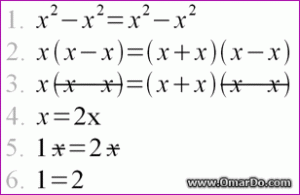

Well that's it for this week. Enjoy :)
Monday, 17 September 2012
Monday Maths Madness 9
I don't have any pictures this week, so I thought I would share some interesting (well I think so anyway!) facts about a number everyone knows: 666.
The number 666 is probably most commonly known as the Number of the Beast, from the biblical book of Revelation. However, it also has some interesting mathematical properties. First of all, 666 is equal to the sum of the squares of the first seven primes (seven being considered a magic number, as an extra little fact). In other words:
As well as this cool coincidence, 666 is the sum of palindromic (meaning it reads the same backwards as it does forwards) cubes.
And just to add to the weirdness, the 63 in the centre is shorthand for 6 x 6 x 6.
So, is 666 the Number of the Beast, or the Number of the Numerologist?
The number 666 is probably most commonly known as the Number of the Beast, from the biblical book of Revelation. However, it also has some interesting mathematical properties. First of all, 666 is equal to the sum of the squares of the first seven primes (seven being considered a magic number, as an extra little fact). In other words:
666 = 22 + 32 + 52 + 72
+ 112 + 132 + 172
As well as this cool coincidence, 666 is the sum of palindromic (meaning it reads the same backwards as it does forwards) cubes.
666 = 13 + 23 + 33 + 43
+ 53 + 63 + 53 + 43 + 33
+ 23 + 13
And just to add to the weirdness, the 63 in the centre is shorthand for 6 x 6 x 6.
So, is 666 the Number of the Beast, or the Number of the Numerologist?
Monday, 10 September 2012
When my little brother sees my maths work
In preparation for University maths, I have been looking at some sample questions before I try an online test. I left it alone for a few minutes with my little brother and came back to this...

Clearly he wasn't a fan. Funnily enough, I was having trouble with the question, and was feeling a little 'sad face' myself. At least he didn't eat it, like he used to do with my homework.
Monday Maths Madness 8

More reality broken down into equations. I particularly like the modern art one. I sometimes really don't understand art. I'm still not convinced by the purple square I saw in the Tate gallery once.

The pigeons in this picture just happen to be sitting distances apart that reflect the distances between the numbers in the Fibonacci sequence (I still need to write that post. Soon I promise!) Even pigeons can do maths! Either that or it is a coincidence. Either way, it's pretty cool. I think so anyway.

Subscribe to:
Posts (Atom)